

Your watch tells you your VO2 max. Your coach tells you it matters.
Two magazine articles from last year told you opposite things about whether to chase it.
VO2 max is the most cited, most misunderstood number in endurance running.
Here’s what it actually measures, what a good score looks like for your age and sex, and the specific workouts that raise it.
You’ll learn:
- What VO2 max is and how it’s measured
- Typical and elite VO2 max values by age and gender
- Why two runners with identical VO2 max scores can finish minutes apart
- The four factors that raise or lower your VO2 max
- A four-method training framework to increase it
- Race-specific workouts for the 5k, 10k, half, and marathon
- Whether a lab VO2 max test is worth the money
What is VO2 max?
VO2 max is the maximum amount of oxygen your body can use during all-out exercise, measured in milliliters per kilogram of body weight per minute (ml/kg/min).
The number captures two things working together: how much oxygen-rich blood your heart pumps each beat, and how efficiently your working muscles pull that oxygen out of the blood and turn it into energy.
The bigger the number, the larger your aerobic engine.
A bigger engine gives you more raw ceiling for endurance performance. It’s the most widely used lab measure of cardiorespiratory fitness, which is why your watch, your doctor, and your coach all talk about it.
VO2 max training works by stressing the aerobic energy system hard enough to force adaptations in your heart, blood, and muscle mitochondria.
How is VO2 max measured?
A lab VO2 max test has you running on a treadmill wearing a breathing mask that captures every breath you exhale. The workload ramps up every two to three minutes until you can’t continue.
During the test the analyzer tracks two variables: how much oxygen is in the air you breathe in, and how much oxygen is left in the air you breathe out. The difference is the oxygen your body used.
Divide that by your body weight in kilograms and your test duration in minutes, and you get your VO2 max in ml/kg/min.
A valid VO2 max test requires you to reach a plateau in oxygen uptake even as the workload keeps climbing.
That’s why the test has to go to exhaustion. Stopping early gives you VO2 peak, not VO2 max, and the two aren’t interchangeable.
Lab tests are the gold standard. Watch estimates use your heart rate response to a run plus your pace and are typically accurate within 3 to 5 ml/kg/min for well-trained runners.
What is a good VO2 max score by age and gender?
Good is relative to your age, your sex, and how you train. A 55 ml/kg/min score is elite for a 45-year-old woman and average for a collegiate male runner.
These ranges come from population norm data for active adults.
| Age | Men – Average (ml/kg/min) | Men – Excellent | Women – Average | Women – Excellent |
|---|---|---|---|---|
| 20–29 | 42–47 | 55+ | 36–41 | 49+ |
| 30–39 | 40–45 | 52+ | 34–39 | 45+ |
| 40–49 | 37–42 | 48+ | 32–36 | 42+ |
| 50–59 | 34–39 | 44+ | 28–32 | 39+ |
| 60–69 | 31–36 | 40+ | 25–29 | 35+ |
Reviews of elite endurance physiology place top male marathoners between 70 and 85 ml/kg/min and top female marathoners between 60 and 78 ml/kg/min.
Men typically score 10 to 15% higher than women at the same age and training level because of larger heart volume, higher hemoglobin concentration, and greater lean muscle mass.
The difference shrinks when you control for those variables, but it never disappears entirely.
A low VO2 max for your age and sex is the single strongest marker that your cardiovascular system has room to grow.
Does a higher VO2 max always make you faster?
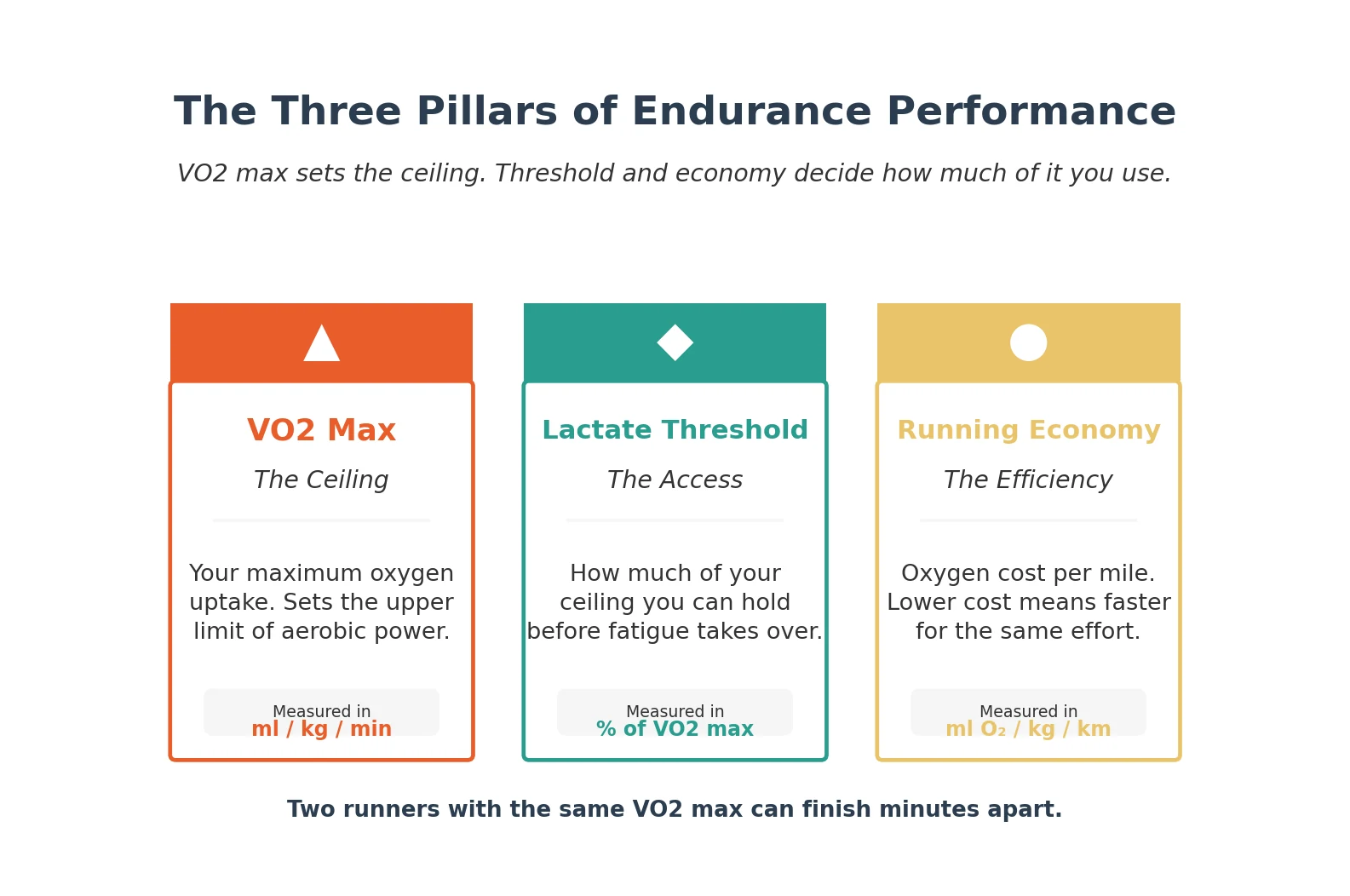
A higher VO2 max gives you a bigger ceiling. Whether you run near that ceiling depends on two other factors: your lactate threshold and your running economy.
Research from the Breaking2 and Ineos 1:59 projects found an inverse relationship between VO2 max and running economy in sub-2:05 marathoners, meaning the most economical runners often had the lower VO2 max scores.

Two runners with identical VO2 max values can finish a 10k minutes apart because one burns less oxygen at goal pace than the other.
Running economy is how much oxygen it takes you to run a given pace. Better economy means less oxygen needed per mile.
Lactate threshold is the fastest pace you can hold before fatigue chemistry takes over. A higher threshold lets you use a bigger slice of your VO2 max before slowing down.
The three work together: VO2 max sets the ceiling, threshold sets how much of the ceiling you access, and economy sets the gas mileage.
What factors affect your VO2 max?
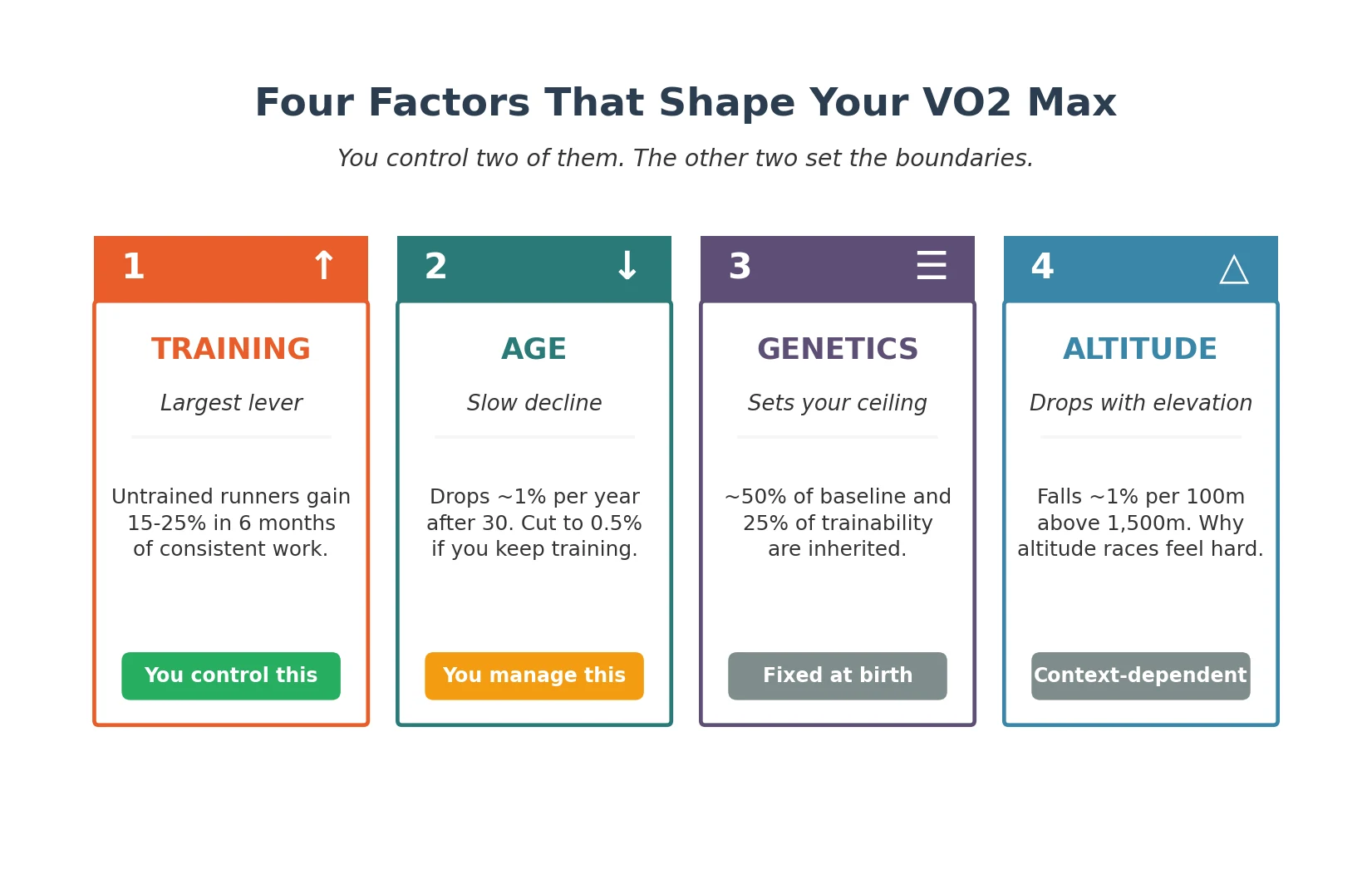
Four variables shape your score, and you have meaningful control over only two of them.
Training. The most modifiable factor, and the one that moves your score the fastest.
Untrained runners see gains of 15 to 25% in the first six months of consistent training, and experienced runners still make measurable gains with targeted interval work.
Age. VO2 max peaks in your mid-20s and declines about 1% per year after 30 in sedentary adults.
Longitudinal data on masters athletes shows consistent training cuts that decline roughly in half, to about 0.5% per year.
Genetics. The HERITAGE Family Study attributes roughly 50% of your untrained VO2 max and about 25% of your trainability to inherited factors.
Genetics set the ceiling of your ceiling.
Altitude. Oxygen availability drops with elevation, so VO2 max falls about 1% for every 100 meters above 1,500 meters.
That’s why racing at altitude requires pace adjustments.
How do you increase your VO2 max?
Intervals run at 90 to 100% of your VO2 max pace, three times per week for eight weeks, produce the largest and fastest gains in aerobic capacity.
A 2013 meta-analysis of 14 high-intensity interval training studies found an average VO2 max improvement of 4.2 ml/kg/min in trained endurance athletes over 6 to 12 weeks of structured interval work.
Four training methods do the heavy lifting.
Classic VO2 max intervals. 3 to 6 minutes hard, 2 to 3 minutes easy, repeated 4 to 6 times.
Pace should feel like 3k to 5k race effort. This is the workhorse of VO2 max training.
Short high-intensity intervals. 30 to 60 seconds all-out, 30 to 60 seconds easy, repeated 10 to 20 times. These push peak oxygen uptake without the cumulative fatigue of longer reps.
Hill repeats. 60 to 90 seconds uphill at hard effort, jog down recovery, 6 to 10 reps. Hills load the muscles hard at lower mechanical stress than flat-ground intervals.
Threshold work. Lactate threshold training raises the percentage of VO2 max you can sustain during a race.
Two threshold sessions per week complement the interval work and deepen the aerobic base that VO2 intervals sit on top of.
Strength training twice per week for 30 minutes also matters. Stronger muscles need less oxygen to hold a given pace, so every session of threshold and interval work buys you a bigger return.
Recovery is the quiet multiplier. VO2 max adaptations happen during sleep and easy days, so stacking two hard days back to back stalls the gains.
RunnersConnect Bonus
Download our Heart Rate Calculator to find out what your individual heart rate zones are.
What are the best VO2 max workouts by race distance?
VO2 max contributes differently to each distance. The 5k sits right at VO2 max pace, while the marathon draws on it indirectly.
VO2 max workouts for the 5k
The 5k is run at roughly 95 to 100% of VO2 max. Specificity matters most here.
Three proven sessions:
- 12 x 400m at 1-mile to 3k pace, 1:30 to 2:00 jog recovery
- 8 x 800m at 5k pace, 90 seconds easy jog between
- 5 x 3 minute hills at hard effort, jog down recovery
For progressions and base work before VO2 intervals, see our 5k specific training guide.
VO2 max workouts for the 10k and half marathon
The 10k runs at 85 to 95% of VO2 max, and the half runs at 80 to 88%.
One VO2 session every 10 to 14 days keeps the system sharp without eating into long-run and tempo capacity.
- 6 x 1000m at 5k to 10k pace, 2:00 jog recovery
- 4 miles of cruise intervals: 400m at 3k pace, 1200m at marathon pace, alternating
- 4 x 2 minute hills, then 1 mile flat at 10k pace, then 4 x 2 minute hills
VO2 max workouts for the marathon
The marathon runs at about 75 to 82% of VO2 max, so the ceiling matters less than threshold and economy.
A VO2 session every three to four weeks is enough.
- 2 sets of 10 x 400m at 5k pace, 200m jog between reps, 400m jog between sets
- 20 x 200m at mile to 3k pace, 200m jog recovery
- 6 x 3 minutes at 3k to 5k pace, 3 minutes walk or jog between
Can a high VO2 max protect your long-term health?
Low cardiorespiratory fitness is a stronger predictor of all-cause mortality than smoking, diabetes, and hypertension combined.
A JAMA Oncology analysis of almost 14,000 men followed for 38 years found that each 1 ml/kg/min increase in midlife VO2 max was associated with a 14% lower risk of dying from lung or colorectal cancer.
The protective effect comes from more than the number itself. Higher aerobic fitness correlates with lower resting heart rate, better blood lipid profiles, lower systemic inflammation, and improved insulin sensitivity.
For most runners this is the quietly important reason to keep training.
Is a VO2 max test worth it for most runners?
For most everyday runners, a lab test is expensive and adds little training value. A race result or a consistent watch estimate tells you roughly what you need to know.
A lab test makes sense in three cases.
Diagnostic baseline. If you’ve plateaued for 12 months despite consistent training, a lab test can reveal whether the ceiling, threshold, or economy is the problem.
Competitive athletes. Sub-elite and elite runners benefit from precise VO2 max and velocity at VO2 max (vVO2 max) data for pacing intervals.
Medical screening. A low VO2 max after age 45 is a reason to see a cardiologist before pushing hard intervals.
Some labs offer VO2 max tests specifically for cardiac screening.
For the other 90% of runners, your watch estimate plus a recent 5k or 10k race gives you everything a lab test would reveal, and costs nothing.
The value of a VO2 max test lives in the interpretation.
If you don’t have a coach or training partner who can read the results against your race history, the number alone won’t change what you do tomorrow morning.




4 Responses
Hi
I was wondering if there are any online courses that review how the V02 Max test is administsered
A simple fact about running know by the old coaches, is that when your unable to talk while running, you have hit your vo2max, slow your speed and see if you can talk again.
Thanks for the comment Luis. Very true, when it comes to easy running, you should be able to have a conversation, which means you are running slow enough for your body to be able to recover.
Just wishing to take a vo2 test just to see how my asthma effects my ability to compete in cycling events.